
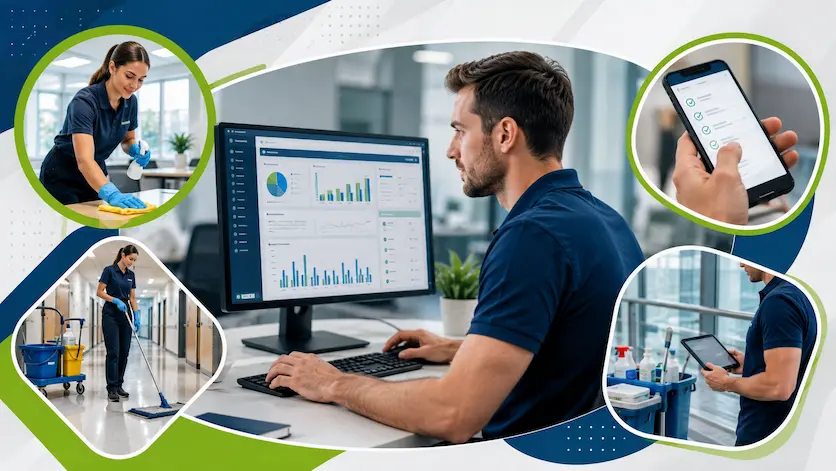
Ask two facilities managers what makes a cleaning contract feel “in control” and they’ll describe the same thing: they can see what was done, know when it wasn’t, and prove it to their stakeholders. Increasingly, that visibility comes from CAFM — computer-aided facilities management software. This guide explains what CAFM is, how it improves cleaning delivery specifically, and what to look for when a provider says they use it.
Quick answer: CAFM (computer-aided facilities management) is software that plans, tracks and reports on facilities work — including cleaning. For cleaning, it turns a paper rota into a live system: scheduled tasks, mobile sign-off by cleaners, logged reactive requests, audit scores and reporting dashboards. The benefit isn’t the technology itself but the visibility and accountability it creates — you can see cleaning was done, respond faster when it isn’t, and evidence performance against the contract.
What CAFM actually is
CAFM is the digital backbone many facilities teams use to manage buildings — assets, planned maintenance, reactive jobs, compliance and space. Cleaning is one of the services it coordinates. Instead of a clipboard and a wall-mounted schedule, tasks live in a system that assigns them, records completion, captures issues and produces reports. Some providers run their own CAFM or workforce-management platform; larger clients often have their own, and expect their cleaning contractor to work within it. Either way, the shift is from cleaning being invisible between visits to cleaning being a tracked, evidenced service.
How CAFM improves cleaning delivery
| Capability | What it does for cleaning |
|---|---|
| Scheduled tasks | The frequency spec is loaded as digital tasks, so periodic work (carpet, high-level, descale) is prompted and not forgotten |
| Mobile sign-off | Cleaners confirm completion on a phone/tablet, sometimes with photos or QR/NFC scans at location — proof of presence and work |
| Reactive logging | Spills, shortages and issues are raised as tickets with a response time, so nothing relies on memory |
| Audit & QA | Supervisor audits are scored in-app against the spec, building a trend rather than a filed-and-forgotten form |
| Reporting dashboards | Completion rates, audit scores and response times roll up into reports for the client — the contract made visible |
The real benefit: accountability, not gadgets
It’s easy to be sold on the technology. The value is what the technology forces into the open. A paper rota can hide a missed periodic clean for months; a CAFM task list shows it immediately. A verbal complaint can evaporate; a logged reactive ticket has a timestamp and a resolution. An audit form in a drawer proves nothing; a scored trend line shows whether standards are improving or slipping. For a facilities manager who has to answer to finance, compliance or a board, that evidence is the point. It moves the conversation from “I think it’s being cleaned properly” to “here’s the data.”
Where it helps most
CAFM earns its keep on larger, multi-area or multi-site contracts where informal oversight can’t scale. On a single small office, a good supervisor and a clear spec may be enough. Across several floors, buildings or a portfolio — or in regulated environments that must evidence compliance — the ability to schedule, track, log and report centrally is what keeps standards consistent and provable. It’s closely tied to how a provider structures KPIs and audits: the software is where those measures actually live and get reported.
What to ask a provider about CAFM
- Do you provide cleaning completion and audit reporting, and in what format and frequency?
- How are periodic tasks scheduled and confirmed so they aren’t missed?
- How do I raise a reactive issue, and what’s the logged response time?
- Can you work within our existing CAFM system if we have one?
Strong answers show a provider that treats cleaning as a managed, measurable service. That’s the same mindset behind good KPIs and SLAs, and it’s core to how professional facilities management and cleaning is delivered rather than just promised.
Want cleaning you can actually see reported?
We deliver cleaning as a tracked, evidenced service — scheduled tasks, sign-off, reactive logging and audit reporting — and can work within your facilities systems.
Request your free quoteor call 020 8993 3831
Frequently asked questions
What is CAFM software?
CAFM stands for computer-aided facilities management — software that plans, tracks and reports on facilities work such as maintenance, compliance, space and cleaning. For cleaning it replaces a paper rota with a live system: scheduled tasks, mobile completion sign-off, logged reactive requests, scored audits and reporting dashboards. The point isn’t the technology itself but the visibility and accountability it creates, so you can see cleaning was done, respond quickly when it isn’t, and evidence performance against the contract.
How does CAFM improve cleaning?
It makes cleaning a tracked service rather than an invisible one. The frequency spec becomes digital tasks so periodic work isn’t forgotten; cleaners sign off completion on a phone or tablet, sometimes with photos or location scans; spills and shortages are logged as tickets with response times; supervisor audits are scored in-app to build a trend; and completion rates, audit scores and response times roll up into client reports. Together that turns “I think it’s clean” into demonstrable data.
Do I need CAFM for a small office clean?
Not necessarily. On a single small office, a good supervisor and a clear written specification may deliver all the oversight you need. CAFM earns its keep on larger, multi-area or multi-site contracts where informal oversight can’t scale, and in regulated environments that must evidence compliance. The bigger and more dispersed the estate, the more the ability to schedule, track, log and report centrally is what keeps standards consistent and provable across everything.
Can a cleaning provider work within our own CAFM system?
Many can, and it’s worth asking directly. Larger clients often run their own CAFM or helpdesk system and expect the cleaning contractor to log jobs, sign off tasks and report within it. A capable provider will either integrate with your platform or provide their own reporting that maps to your requirements. Confirming this before contract award avoids a mismatch where your oversight expectations and the provider’s tools don’t line up once they mobilise.
Is CAFM the same as a cleaning audit?
No, but they connect. A cleaning audit is the inspection of work against a standard; CAFM is the system where audits — along with schedules, sign-offs and reactive tickets — are recorded, scored and reported. In other words, the audit is the activity and CAFM is often where its results live and trend over time. Using software to hold audit scores turns one-off checks into a visible performance trend, which is far more useful for managing a contract.
About The Author