
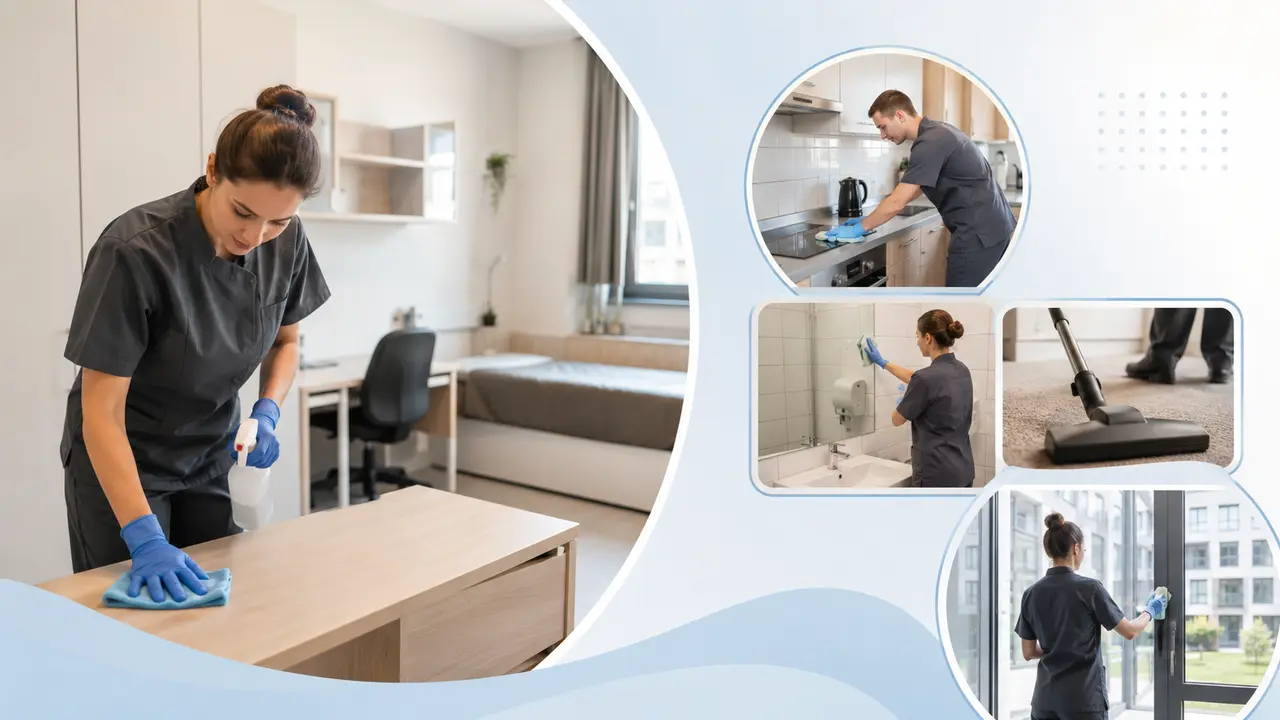
A student accommodation cleaning contract is not one service but two rhythms in one agreement: steady communal cleaning during term, and an intensive room-by-room reset over the summer. This guide breaks down exactly what a proper contract should cover, area by area, so accommodation and procurement teams can compare providers on like for like and know what to check before signing.
Quick answer: A good contract covers term-time cleaning of communal areas, kitchens and washrooms plus a summer void turnaround that deep-cleans every study bedroom and en-suite between tenancies. It should also spell out consumables and waste, day-porter or out-of-hours cover, compliance (DBS, RAMS, COSHH, accreditations), and a written specification with quality audits — so nothing is left vague.
The two halves of the contract
The defining feature of student accommodation cleaning is the academic calendar. In term time, students are living in, so the focus is keeping shared spaces clean and healthy without disrupting residents. Over the summer, the building largely empties and the focus flips to a high-volume turnaround — clearing, deep-cleaning and resetting every room before the next intake. A contract that only describes one of these halves is incomplete. Make sure both the term-time schedule and the turnaround programme, with their separate resourcing, are written down.
What’s covered, area by area
| Area | Typically covered |
|---|---|
| Communal areas & corridors | Vacuuming, mopping, high-touch sanitising, common rooms and social spaces reset, waste and recycling |
| Shared & cluster kitchens | Worktops, sinks, appliance exteriors, floors and tables cleaned; deep degrease on a cycle |
| En-suites & shared bathrooms | Toilets, showers, basins and tiles cleaned, descaled and sanitised; consumables restocked where included |
| Study bedrooms | Cleaned as part of the void turnaround between tenancies (not usually in term while occupied) |
| Laundries, gyms & amenities | Machines, equipment surfaces and floors cleaned; shared amenity spaces tidied |
| Summer void turnaround | Full clear-down and deep clean of every room and communal space, tracked to check-in dates |
Which areas are cleaned in term versus at turnaround — and how often — should be set out in your specification and itemised in the quote.
The things people forget to check
The scope of surfaces is the obvious part. The gaps that cause disputes are usually the operational details:
- Consumables — who supplies and restocks soap, toilet roll and hand towels
- Waste & recycling — collection, bin management and food caddies
- Day porters & out-of-hours cover for busy periods and arrival weekends
- Cover for sickness, holidays and peak turnaround
- Compliance — DBS checks, RAMS, COSHH and accreditations
- TUPE — how existing staff transfer if you’re switching provider
Compliance is non-negotiable in student buildings
Cleaning student accommodation means working in and around a resident population, which raises the bar on safeguarding and safety. A contract should be delivered by DBS-checked, trained and supervised operatives, working to method statements and risk assessments (RAMS) with COSHH-compliant products. Accreditations such as ISO 9001, BICSc and SafeContractor give accommodation and procurement teams the assurance they need for institutional and nomination-agreement requirements. If a provider can’t evidence these, that’s a red flag.
Why a written specification protects you
The single biggest cause of cleaning disputes is a mismatch of expectations. A clear, written specification — area by area, task by task, with frequency, plus a defined turnaround scope and quality-audit process — turns a vague promise into an accountable standard. It also makes quotes genuinely comparable, because you can see whether a cheaper provider has simply left tasks out or under-resourced the summer window. Ask for it before you sign, not after the first complaint.
Get a clear student accommodation cleaning specification
Free site survey across London. We agree exactly what’s cleaned, how often and to what standard — term-time and turnaround — then quote it transparently.
Request your free quoteor call 020 8993 3831
Frequently asked questions
What does a student accommodation cleaning contract cover?
It covers term-time cleaning of communal areas, kitchens and washrooms, plus a summer void turnaround that deep-cleans every study bedroom and en-suite between tenancies. It should also define consumables and waste management, day-porter or out-of-hours cover, compliance requirements, and a written specification with quality audits.
Are study bedrooms cleaned during term time?
Usually not while occupied — during term the focus is communal areas, kitchens and shared washrooms. Study bedrooms are cleaned as part of the void turnaround between tenancies. Some schemes add optional in-term room cleans as an extra, which can be written into the specification if required.
Are consumables and cleaning materials included?
It depends on the contract. Some operators supply their own materials and consumables; others have the provider supply chemicals, equipment and washroom consumables such as soap, toilet roll and hand towels. A good provider itemises this clearly in the quote so there’s no ambiguity.
What compliance should a cleaning provider have?
Because the work is around residents, operatives should be DBS-checked, trained and supervised, working to RAMS and COSHH-compliant processes. Accreditations such as ISO 9001, BICSc and SafeContractor, plus full insurance, give accommodation and procurement teams the assurance required for institutional and nomination-agreement standards.
What happens to existing cleaning staff if we switch provider?
Where a cleaning contract transfers to a new provider and existing staff move across, TUPE may apply. A compliant handover protects continuity and standards while the people who already know your building continue to look after it. A good provider will advise whether TUPE is relevant during mobilisation.
About The Author