
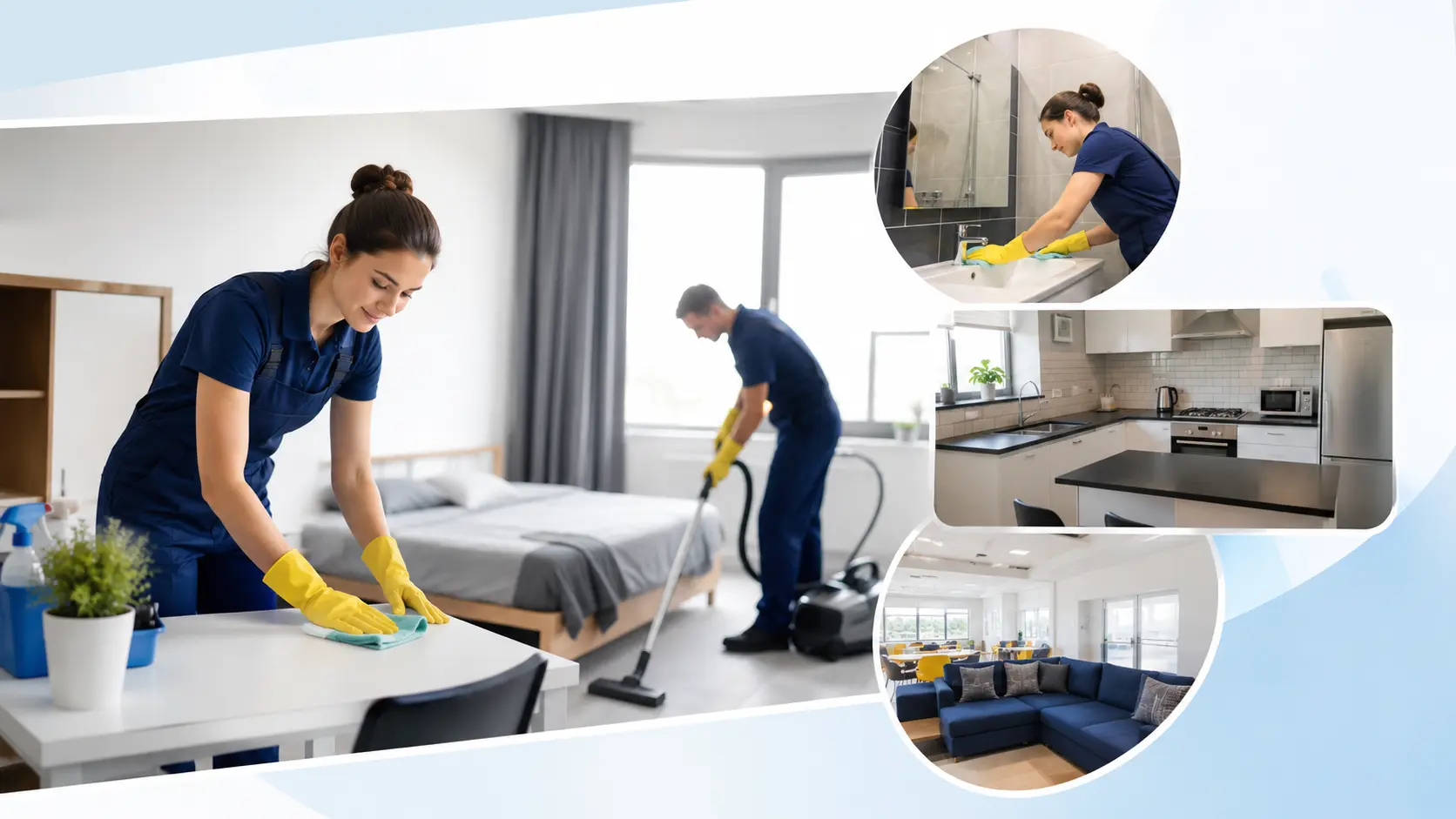
In student accommodation, the summer changeover is the hardest job of the year: every room has to be cleared, deep-cleaned and reset in a matter of weeks before the next intake arrives. This guide explains how a summer void turnaround works, how to plan one that hits your check-in dates, and what a good cleaning partner should take off your plate.
Quick answer: A summer void turnaround is the deep clean and reset of every study bedroom, en-suite, kitchen and communal space between one cohort of students leaving and the next arriving. It runs to a tight window over the summer, is resourced separately from term-time cleaning, and is tracked room by room against a handover specification so managers always know exactly what’s ready for check-in.
Why the summer window is so unforgiving
Unlike an office, student accommodation empties and refills almost completely within a fixed calendar. Students move out at the end of the academic year, and a new cohort arrives on a set arrival weekend — with summer conference guests and short-stay lettings often squeezed in between. That leaves a narrow window in which hundreds or thousands of bed spaces must be cleaned to a check-in standard, alongside maintenance, repairs and inspections. Miss the dates and you have students arriving to unready rooms, complaints on day one, and reputational damage that affects re-lettings. The turnaround is the single biggest operational test of the year for any PBSA operator or university accommodation team.
What a summer void turnaround covers
| Area | Turnaround scope |
|---|---|
| Study bedrooms | Full clear-down, beds, desks, wardrobes and surfaces wiped and sanitised, floors vacuumed or mopped, internal windows and sills cleaned |
| En-suites | Deep clean, descale and sanitise of showers, toilets, basins, taps and tiles; mirrors and fixtures polished |
| Cluster & communal kitchens | Degrease and deep-clean worktops, hobs, ovens, microwaves and fridges; cupboards, floors and appliances reset |
| Communal areas | Corridors, stairwells, common rooms, laundries and social spaces cleaned and reset |
| Handover checks | Each room inspected against the specification and marked ready, with issues flagged to maintenance |
Exact scope is agreed in your specification during a free site survey — some schemes add carpet extraction, window cleaning or hard-floor treatment into the void programme.
Planning a turnaround that hits your dates
A successful turnaround is a logistics exercise as much as a cleaning one. It starts with three numbers: how many bed spaces, how many days in the window, and your hard check-in date. From there the team is scaled and sequenced so blocks are cleared in a logical order — usually floor by floor or block by block — and coordinated with maintenance so a room isn’t cleaned before a repair reopens it. Progress is tracked room by room, so at any point a manager can see what’s done, what’s in progress and what’s outstanding. That visibility is what turns a stressful scramble into a controlled programme.
The typical sequence
- Site survey and room-by-room specification agreed before term ends
- Team scaled to bed-space count and handover dates
- Clear-down and deep clean, sequenced block by block
- Coordination with maintenance, repairs and inspections
- Room-by-room sign-off against the specification
- Snagging and final checks before arrival weekend
Where turnarounds go wrong
Most turnaround failures trace back to the same causes: under-estimating the team needed for the window, no clear sequence so blocks are half-finished, poor coordination with maintenance, and no room-level tracking so problems surface too late. A specialist contractor plans for peak — scaling labour up for the summer and back down for term — rather than trying to stretch a term-time team across a job several times its size. That flexibility is exactly why many operators bring in a dedicated partner for the void rather than relying on in-house staff alone.
Plan your summer turnaround with Crystal
Free site survey across London. We scope your scheme, scale the team to your handover dates, and track every room to check-in — quoted transparently.
Request your free quoteor call 020 8993 3831
Frequently asked questions
What is a summer void turnaround in student accommodation?
It’s the deep clean and reset of every study bedroom, en-suite, kitchen and communal space between one cohort of students leaving and the next arriving. It runs to a tight summer window, is resourced separately from term-time cleaning, and is tracked room by room against a handover specification so every room is ready for check-in.
How quickly can a turnaround be completed?
It depends on the number of bed spaces, the scope of the clean and your target check-in date. A specialist scales the team to the window rather than stretching a fixed team, and sequences the work block by block. The realistic timescale is agreed after a free site survey based on your actual scheme and dates.
Does the turnaround include kitchens and en-suites?
Yes. A full void turnaround covers study bedrooms, en-suites, cluster and communal kitchens and communal areas — with degreasing, descaling and sanitising as standard. Add-ons such as carpet extraction, window cleaning and hard-floor treatment can be built into the programme if needed.
Can you handle summer conference and short-stay lettings between cohorts?
Yes. Many schemes run summer conference or short-stay guests between the student cohorts. We can build additional resets and cleans around those lettings, coordinating with your bookings so rooms are ready for each changeover as well as the main student arrival.
How do you make sure every room is ready for check-in?
Each room is inspected against the agreed specification and marked ready, with any issues flagged to maintenance. Progress is tracked room by room so managers can see at any point what’s done, in progress and outstanding — and a final snagging pass is run before the arrival weekend.
About The Author