
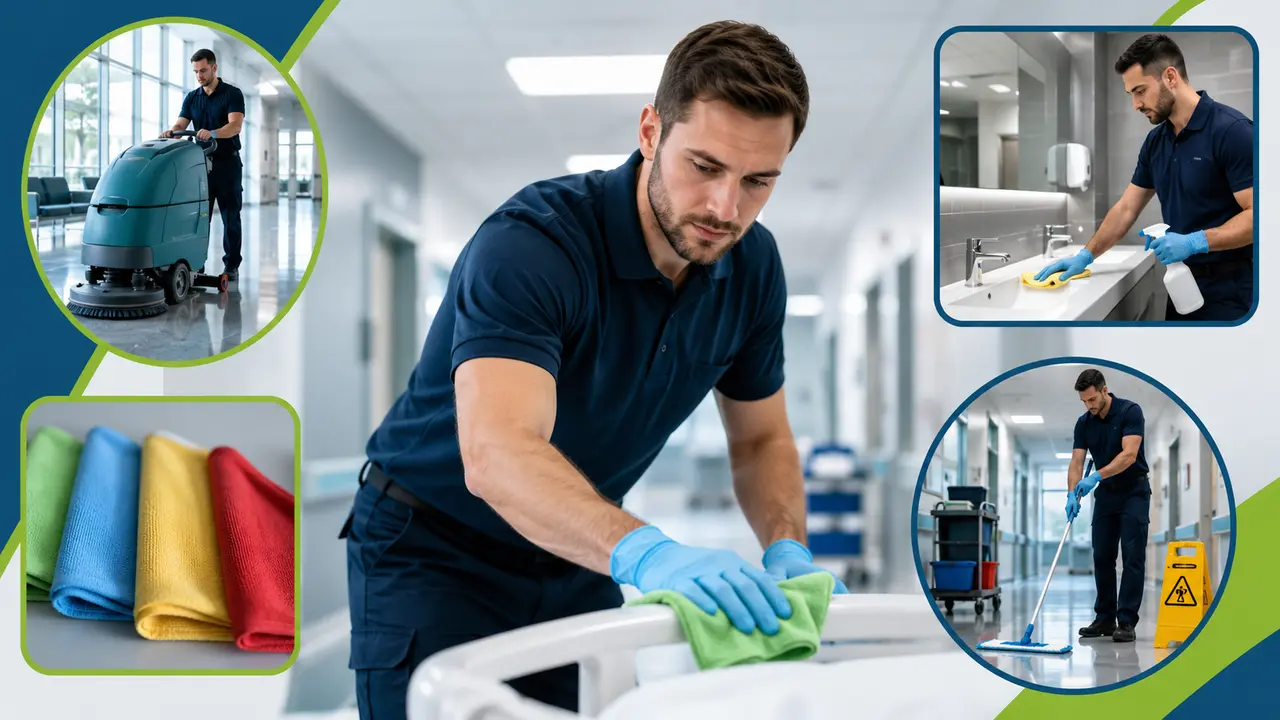
If you’ve read cleaning tenders or provider credentials, you’ll have seen “BICSc-trained” and “BICSc-accredited” used as marks of quality. But what does BICSc actually stand for, and why does it matter when you’re choosing a cleaning contractor? This guide explains what BICSc is, what its standards cover, and how they translate into consistent, safe cleaning on the ground — especially in demanding environments like healthcare.
Quick answer: BICSc is the British Institute of Cleaning Science, the largest independent professional and educational body for the cleaning industry in the UK. Its standards define how cleaning tasks should be carried out — through structured training, assessed skills and recognised methods such as colour coding. “BICSc-trained” means operatives have been taught and assessed to a recognised benchmark, which brings consistency, safety and accountability to how cleaning is delivered.
What BICSc is
The British Institute of Cleaning Science is a professional body dedicated to raising standards in the cleaning industry through education and training. Rather than regulating premises, BICSc focuses on people and method: it develops training, sets assessable skills standards, and accredits organisations that train and work to them. Because cleaning quality ultimately depends on whether operatives follow the right method every time, a body focused on skills and technique fills an important gap. For clients, BICSc credentials are a shorthand for a provider that trains its people properly rather than leaving method to chance.
What BICSc standards cover
BICSc standards run through the practical side of cleaning — the how, not just the what:
| Area | What it covers |
|---|---|
| Skills training | Structured training in cleaning tasks, taught and assessed to a defined standard |
| Assessment | Operatives are observed and signed off as competent, not just given a certificate |
| Colour coding | The recognised system for separating equipment by area to prevent cross-contamination |
| Safe method | Correct technique, chemical use and equipment handling, aligned with health & safety |
| Consistency | The same task performed the same safe way by every operative, every time |
The colour-coding system many people recognise — separate cloths and equipment for washrooms, general areas and so on — is a good example of a simple, trainable method that prevents cross-contamination.
Why it matters when choosing a provider
Cleaning is only as good as the method behind it, and method comes from training. A provider whose operatives are BICSc-trained is one that has invested in teaching its people the right technique and assessing that they can do it. That shows up in the results: more consistent standards, fewer mistakes, safer chemical and equipment use, and a workforce that understands why a method matters, not just that it exists. In regulated environments this is doubly important — it underpins the infection-control practices that CQC and NHS frameworks expect.
What good looks like on the ground
BICSc training shows up in everyday habits you can actually observe:
- Correct colour-coded equipment used in the right areas, consistently
- Chemicals diluted and applied correctly, with COSHH awareness
- Cleaning worked methodically from clean areas to dirty
- Equipment cleaned, stored and maintained properly between uses
- Operatives who can explain why a method is used, not just follow it
- Supervisors upholding the same standard across the whole team
BICSc in a healthcare context
Nowhere does trained method matter more than in healthcare, where a lapse in technique can contribute to infection. BICSc-trained operatives, supervised to clinical hygiene standards, are a foundation for meeting the infection-control expectations of the CQC and the NHS cleaning framework. It’s why healthcare cleaning credentials so often lead with BICSc training alongside ISO accreditation and COSHH-assessed products.
Cleaning delivered to BICSc standards
At Crystal Facilities Management, operatives are BICSc-trained and supervised to clinical hygiene standards, using colour-coded equipment and COSHH-assessed chemicals. That trained method underpins everything from routine office cleaning to specialist healthcare cleaning, and it’s a big part of what makes standards consistent rather than dependent on who happens to be on shift. If you’re comparing providers, it’s worth asking exactly how their people are trained and assessed.
Want cleaning delivered by properly trained operatives?
Free site survey across London. We’ll show you how our BICSc-trained teams work and build a specification that delivers consistent, accountable standards.
Request your free quoteor call 020 8993 3831
Frequently asked questions
What does BICSc stand for?
BICSc stands for the British Institute of Cleaning Science, the largest independent professional and educational body for the cleaning industry in the UK. It focuses on raising cleaning standards through training, assessed skills and recognised methods, rather than regulating premises. Its credentials are widely used as a mark that a cleaning provider trains and assesses its operatives to a recognised benchmark.
What does “BICSc-trained” mean?
It means operatives have been taught cleaning tasks to a defined standard and assessed as competent to perform them — not simply handed a certificate. BICSc training covers correct technique, safe chemical and equipment use, and recognised methods such as colour coding. For clients, it is a shorthand for consistent, safe cleaning delivered the same way by every operative rather than left to individual habit.
Why does BICSc training matter when choosing a cleaner?
Cleaning quality depends on method, and method comes from training. A provider whose operatives are BICSc-trained has invested in teaching and assessing the right technique, which shows up as more consistent standards, fewer mistakes and safer chemical and equipment use. In regulated settings such as healthcare it is especially important, because trained method underpins the infection-control practices that CQC and NHS frameworks expect.
What is the BICSc colour-coding system?
Colour coding assigns different cleaning equipment — cloths, mops and buckets — to different areas so that items used in higher-risk areas such as washrooms are never used elsewhere. It is one of the simplest and most effective ways to prevent cross-contamination, and it is a recognised method taught as part of BICSc training. Used consistently, it is a visible sign that operatives are working to a proper standard.
Is BICSc relevant outside healthcare?
Yes. While trained method is critical in healthcare, BICSc standards apply across all cleaning — offices, education, retail and more. Any environment benefits from operatives who use correct technique, handle chemicals safely and work consistently. BICSc training simply raises the floor on quality wherever it is applied, which is why it features in the credentials of professional providers across many sectors, not just clinical ones.
About The Author