
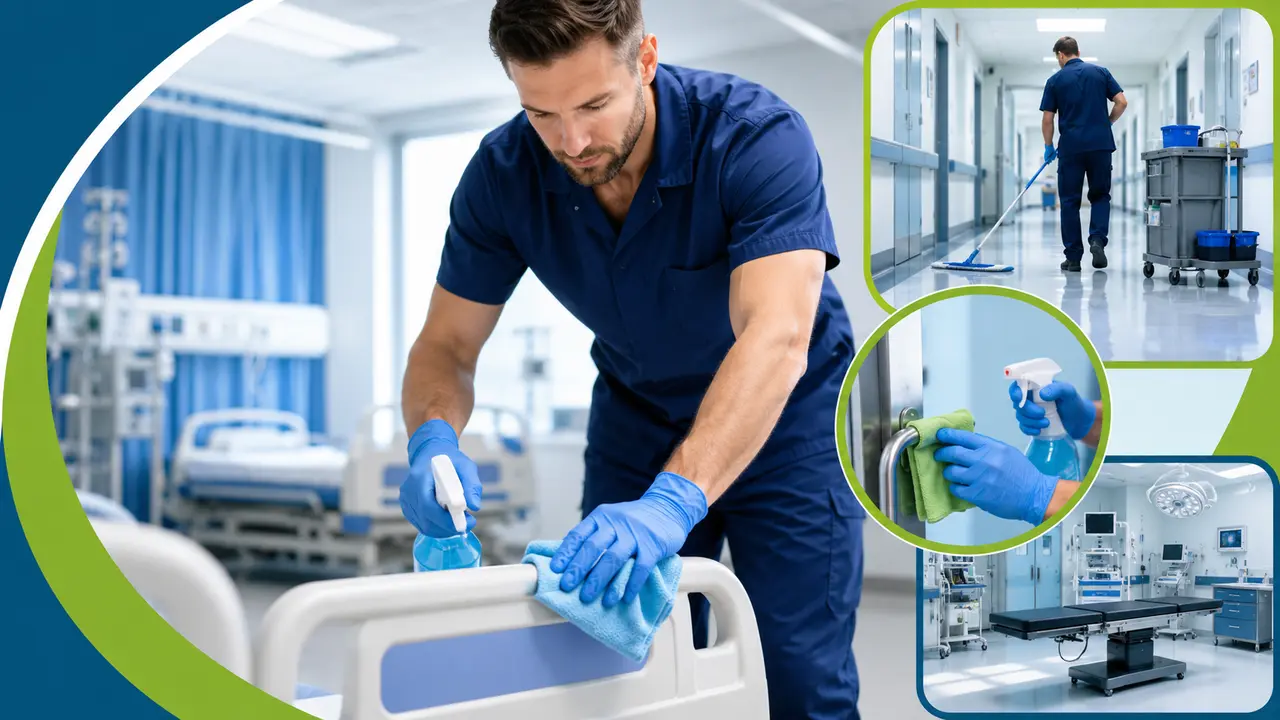
When people ask for “NHS-standard cleaning,” they’re usually referring to a specific framework: the National Standards of Healthcare Cleanliness. It’s the modern successor to the older national cleanliness specifications, and it sets out how cleaning in healthcare settings should be specified, delivered, measured and displayed. If you run or procure cleaning for a hospital, clinic or care setting, understanding how the framework works helps you set a specification that’s genuinely to standard — and prove it. This guide breaks down the key parts in plain terms.
Quick answer: The National Standards of Healthcare Cleanliness is the NHS framework for cleaning in healthcare settings. It divides the environment into functional risk categories (from very high-risk clinical areas to low-risk areas), defines around 50 cleaning elements to assess, and scores cleanliness against them to produce a star rating that’s displayed publicly. It splits responsibility clearly between cleaning and clinical teams, and separates how clean a surface looks from how clean it technically is.
What the standards are — and what came before
The National Standards of Healthcare Cleanliness were introduced by NHS England to replace the older National Specifications for Cleanliness, which had been in place since the mid-2000s. The update reflected how healthcare environments and cleaning had changed, and put more emphasis on transparency, shared responsibility and measurable outcomes. The framework applies across NHS settings and is widely used as the reference point for what “NHS-standard cleaning” means in practice, including by private providers cleaning healthcare premises.
Functional risk categories
Not every part of a healthcare building carries the same infection risk, so the standards group areas into functional risk (FR) categories. Higher-risk areas are cleaned more often and audited more frequently:
| Risk level | Typical areas |
|---|---|
| Very high risk | Operating theatres, critical care, areas with vulnerable or immunocompromised patients |
| High risk | General wards, treatment rooms, emergency departments |
| Significant risk | Outpatient areas, clinics, public toilets |
| Low risk | Offices, non-clinical corridors, administrative areas |
Matching cleaning frequency and audit frequency to risk is the core idea — resource concentrated where the consequences of poor cleanliness are greatest.
Cleaning elements and star ratings
The framework defines a set of cleaning elements — around 50 — that are assessed when auditing an area, covering surfaces, fixtures, fittings and equipment. Audits score performance against these elements, and the results roll up into an overall cleanliness score that’s translated into a star rating. A key feature of the standards is that these ratings are intended to be displayed publicly, so patients and visitors can see how clean an area is measured to be. That transparency is a deliberate driver of accountability: a visible score is harder to ignore than an internal report.
The principles that make it work
Beyond the mechanics, a few principles run through the standards:
- Clear cleaning responsibility charts, so every surface has a named owner (cleaning or clinical)
- A distinction between technical cleanliness and how clean an area looks and feels
- Risk-based frequencies and audit schedules tied to functional risk categories
- Publicly displayed star ratings that make performance visible
- Cleanliness treated as a shared responsibility across the whole team
- Auditing built in, so standards are measured continuously rather than assumed
What this means when you procure cleaning
For anyone specifying healthcare cleaning, the framework is a gift: it gives you a shared language and a measurable benchmark. A good specification maps your areas to functional risk categories, sets frequencies accordingly, assigns responsibility for every element, and bakes in auditing so the star rating reflects reality. A provider that already works to these standards can slot into that framework rather than reinventing it — which is exactly what a healthcare-experienced contractor brings.
Cleaning to NHS standards with Crystal
Crystal Facilities Management is a recognised cleaning provider for the NHS and works to the recognised national specifications for healthcare cleanliness, with BICSc-trained operatives, COSHH-assessed chemicals, colour-coded equipment and documented auditing. Whether you’re a trust, a private hospital or a clinic, cleaning can be specified against functional risk and measured against the framework’s elements. It starts with mapping your environment and its risks — part of a wider healthcare cleaning service — and building auditing in from day one via a clear audit process.
Want cleaning specified and measured to NHS standards?
Free site survey across London. We map your environment to functional risk, set frequencies to match, and build auditing in so standards are measured — not assumed.
Request your free quoteor call 020 8993 3831
Frequently asked questions
What are the National Standards of Healthcare Cleanliness?
They are the NHS framework for cleaning in healthcare settings, introduced by NHS England to replace the older National Specifications for Cleanliness. The standards divide the environment into functional risk categories, define around 50 cleaning elements to assess, score cleanliness against them, and translate the results into a star rating that is displayed publicly. They also set out clear responsibility charts and risk-based audit frequencies.
What does “NHS-standard cleaning” mean?
It generally refers to cleaning delivered and measured against the National Standards of Healthcare Cleanliness. In practice that means mapping areas to functional risk categories, setting cleaning frequencies to match, assigning responsibility for every cleaning element, and auditing performance so it can be scored and star-rated. Private providers cleaning healthcare premises often use the same framework as their reference point.
What are functional risk categories?
Functional risk (FR) categories group areas of a healthcare building by infection risk — from very high-risk areas such as operating theatres and critical care, through high and significant risk, down to low-risk offices and non-clinical corridors. Higher-risk areas are cleaned and audited more frequently. The idea is to concentrate cleaning resource where the consequences of poor cleanliness are greatest.
How does the star rating work?
Areas are audited against the framework’s cleaning elements, and the scores roll up into an overall cleanliness rating expressed as stars. These ratings are intended to be displayed publicly so patients and visitors can see how clean an area is measured to be. The public element is deliberate — a visible score drives accountability and makes underperformance harder to overlook than an internal-only report.
Do the standards apply to private healthcare providers?
The framework is an NHS standard, but private hospitals, clinics and cleaning contractors widely adopt it as the benchmark for what good healthcare cleaning looks like. Using it gives everyone a shared language and a measurable target, and it aligns with the expectations of regulators such as the CQC. A cleaning provider experienced in healthcare can specify and audit against the framework regardless of whether the setting is NHS or private.
About The Author