
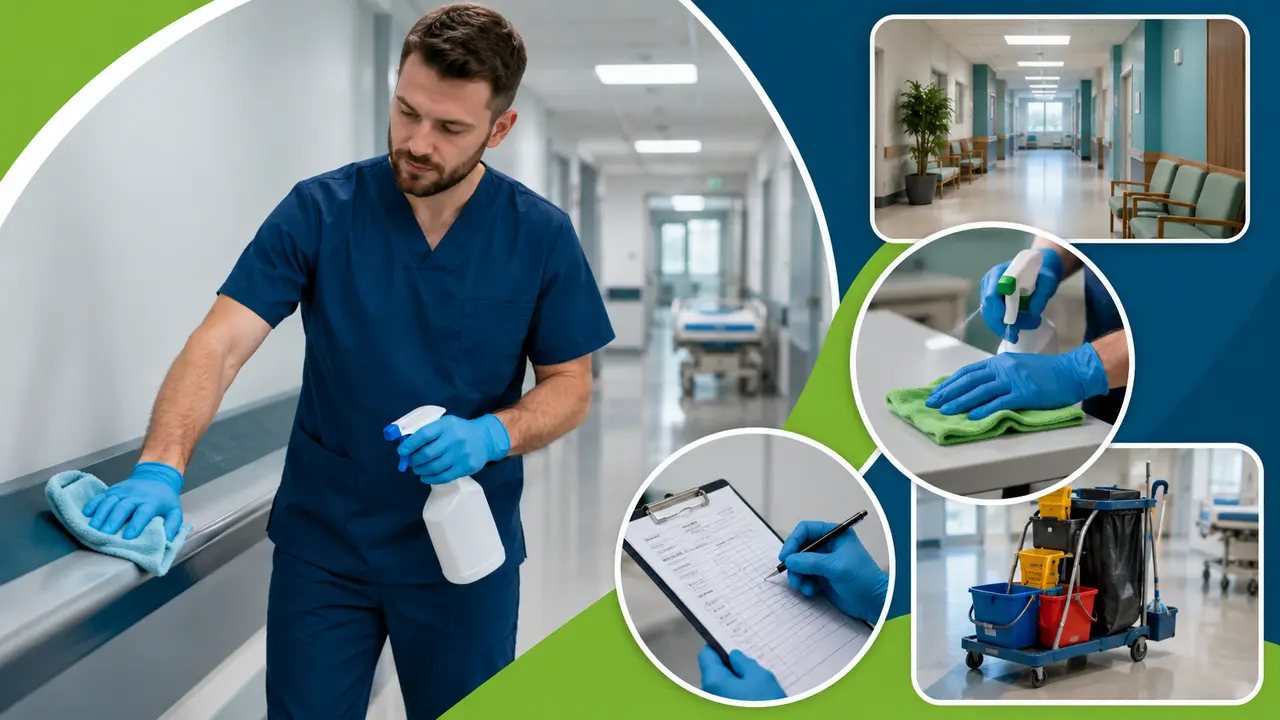
For any hospital, GP surgery, dental practice or care home in England, cleaning isn’t just about appearances — it’s part of how you meet the Care Quality Commission’s fundamental standards. When inspectors look at cleanliness and infection control, they’re checking whether your premises are safe, whether risks are being managed, and whether you can prove it. This guide explains what CQC-compliant cleaning actually means, which regulations it touches, and what a compliant cleaning arrangement looks like in practice.
Quick answer: CQC-compliant cleaning means keeping healthcare premises clean and hygienic in a way that meets the CQC’s fundamental standards — chiefly Regulation 15 (premises and equipment) and Regulation 12 (safe care and treatment), which covers infection prevention and control. In practice that means trained staff, colour-coded equipment, assessed chemicals, risk-based cleaning schedules and — crucially — documented evidence that cleaning is being done to standard. Compliance is judged on whether the environment is safe and whether you can demonstrate it.
What “CQC-compliant cleaning” actually refers to
The Care Quality Commission is the independent regulator of health and adult social care in England. It doesn’t publish a standalone cleaning manual; instead, cleanliness sits inside the fundamental standards that every registered provider must meet. Two regulations do most of the work. Regulation 15 requires that premises and equipment are clean, secure, suitable and properly maintained. Regulation 12 requires safe care and treatment, and explicitly includes assessing and preventing the risk of infection. So when people talk about “CQC cleaning standards,” they really mean cleaning delivered to a level that satisfies these fundamental standards — and that can be evidenced at inspection.
The regulations cleaning touches
It helps to see how cleaning maps onto the standards inspectors actually assess:
| Regulation / framework | What it means for cleaning |
|---|---|
| Regulation 15 — Premises & equipment | Premises and equipment must be clean, suitable, secure and maintained. Direct basis for cleaning standards. |
| Regulation 12 — Safe care & treatment | Providers must assess and prevent the risk of infection — the infection prevention and control (IPC) dimension of cleaning. |
| Code of Practice on IPC | The Health and Social Care Act code the CQC uses to judge IPC arrangements, including cleanliness of the environment. |
| National Standards of Healthcare Cleanliness | The NHS framework many providers use to specify, deliver and audit cleaning to a recognised standard. |
The regulations set the outcome — safe, clean premises — rather than prescribing exact methods. That’s why a defensible cleaning specification and audit trail matter so much.
What a compliant cleaning arrangement includes
Meeting the standards in practice comes down to a handful of things being consistently in place, day in and day out:
- Trained operatives who understand infection prevention and control, not general cleaners
- Colour-coded equipment to prevent cross-contamination between zones
- Chemicals sourced from approved suppliers, each with a COSHH assessment
- Risk-based cleaning schedules that clean higher-risk areas more often
- Clear cleaning responsibility charts so nothing falls between clinical and cleaning teams
- Documented records and audits that evidence what was cleaned, when and to what standard
Why documentation is half the battle
One point that surprises providers new to healthcare inspection: doing the cleaning well is not enough on its own — you have to be able to prove it. Inspectors look for evidence. That means cleaning schedules, completed checklists, audit scores, training records, COSHH assessments and clear lines of responsibility. A clean-looking ward with no records behind it is harder to defend than a well-documented cleaning programme. This is why compliant cleaning is delivered against a written specification with a proper audit trail, rather than on an informal “we clean it regularly” basis. It also protects the provider if standards are ever questioned.
Getting cleaning right for CQC
The reliable route to compliant cleaning is a specification built around risk: identifying the higher-risk areas, setting frequencies accordingly, using trained staff and assessed products, and layering audits on top so standards are measured rather than assumed. Crystal Facilities Management is a recognised cleaning provider for the NHS and works to the Care Quality Commission’s national specifications for cleanliness, with BICSc-trained operatives, COSHH-assessed chemicals and documented processes. If you’d like your arrangement mapped against the fundamental standards, that starts with a review of your healthcare cleaning requirements and the risks specific to your site.
Need cleaning that stands up to CQC inspection?
Free site survey across London. We assess your premises against the fundamental standards and build a risk-based, fully documented cleaning programme.
Request your free quoteor call 020 8993 3831
Frequently asked questions
What does CQC-compliant cleaning mean?
It means cleaning healthcare premises to a level that meets the Care Quality Commission’s fundamental standards — chiefly Regulation 15 (premises and equipment must be clean and suitable) and Regulation 12 (safe care and treatment, including preventing the risk of infection). In practice that requires trained staff, colour-coded equipment, COSHH-assessed chemicals, risk-based schedules and documented evidence that cleaning is being carried out to standard.
Which CQC regulations relate to cleaning?
Two fundamental standards do most of the work. Regulation 15 covers premises and equipment, requiring them to be clean, suitable, secure and maintained. Regulation 12 covers safe care and treatment and includes assessing and preventing the risk of infection. The Code of Practice on infection prevention and control also informs how the CQC judges IPC arrangements, including environmental cleanliness.
Do we need to document our cleaning for the CQC?
Yes. Inspectors look for evidence, not just a clean-looking environment. That means cleaning schedules, completed checklists, audit scores, staff training records and COSHH assessments. A documented cleaning programme is far easier to defend at inspection than informal arrangements, and it protects the provider if standards are ever questioned.
Does the CQC apply to GP and dental practices too?
Yes. The CQC regulates a wide range of providers in England, including GP surgeries, dental practices, care homes and private clinics, not just hospitals. The same fundamental standards apply, so cleaning in these settings still needs to be risk-based, delivered by trained staff using assessed products, and evidenced through records and audits appropriate to the size and risk of the practice.
How is CQC-compliant cleaning different from normal commercial cleaning?
Healthcare cleaning is more specialised and regulated. The risk of healthcare-associated infections means cleaning must follow infection prevention principles — colour-coded equipment, zone-based methods, approved disinfectants and documented schedules — and operatives must be trained accordingly. Standard office or commercial cleaning does not carry these clinical requirements or the same level of audit and evidence.
About The Author