
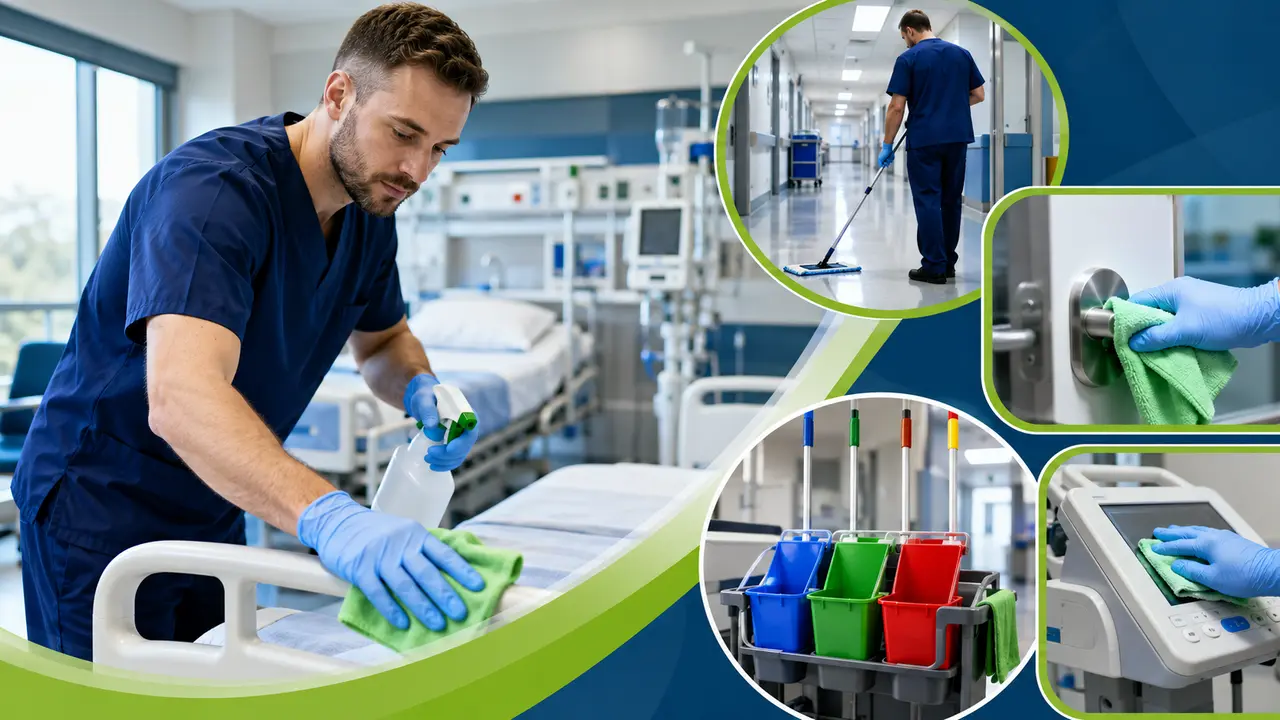
In a healthcare setting, cleaning is one of the front-line defences against infection. Healthcare-associated infections — from MRSA and C. difficile to norovirus — spread through contaminated surfaces and equipment, and the environment plays a real part in that chain. Good infection control cleaning breaks the chain by removing and reducing pathogens where patients and staff actually make contact. This guide explains how infection control cleaning works, why it’s different from ordinary cleaning, and what to expect from a specialist provider.
Quick answer: Infection control cleaning in healthcare focuses on breaking the chain of infection by targeting high-touch surfaces and shared equipment, using colour-coded equipment to prevent cross-contamination between areas, and applying approved disinfectants to the right surfaces at the right frequency. It’s delivered by trained operatives following zone-based methods, cleaning higher-risk areas more often, and evidenced through schedules and audits — all central to preventing healthcare-associated infections (HCAIs).
Why the environment matters to infection control
Pathogens don’t only pass person to person — many survive on surfaces long enough to be picked up by the next hand that touches them. Door handles, bed rails, call buttons, taps, light switches and shared medical equipment are all reservoirs if they aren’t cleaned properly. Some organisms, like C. difficile spores and norovirus, are particularly hardy and need the right products and technique to remove. That’s why environmental cleaning is treated as a genuine clinical control in healthcare, not a cosmetic task. Cleaning to the right standard, in the right places, at the right frequency measurably reduces the risk of transmission.
What makes infection control cleaning different
A few principles separate healthcare infection control cleaning from standard commercial cleaning:
| Principle | What it means in practice |
|---|---|
| Colour coding | Separate equipment for different areas (e.g. washrooms vs clinical areas) to stop cross-contamination |
| High-touch focus | Frequent cleaning and disinfection of the surfaces hands contact most |
| Zone-based methods | Cleaning working from clean areas to dirty, never the reverse |
| Approved disinfectants | Products effective against the relevant organisms, COSHH-assessed and used correctly |
| Risk-based frequency | Higher-risk clinical areas cleaned more often than low-risk offices or corridors |
| Cleaning vs disinfection | Removing soil first, then disinfecting — the two are distinct and both needed |
Cleaning removes dirt and reduces the number of organisms; disinfection then kills what remains on a surface. Skipping the cleaning step makes disinfection far less effective.
The high-touch points that matter most
If you focus cleaning effort anywhere, it’s the surfaces hands contact repeatedly. These deserve attention every visit, regardless of the overall schedule:
- Door handles, push plates and light switches
- Bed rails, call buttons and over-bed tables
- Taps, flush handles and washroom surfaces
- Shared medical equipment and workstation surfaces
- Waiting-room chairs, reception counters and card machines
- Lift buttons, handrails and corridor touch points
Outbreaks and enhanced cleaning
Routine cleaning keeps baseline risk low, but outbreaks call for a step up. A suspected norovirus or C. difficile case usually triggers enhanced or terminal cleaning: the affected area is isolated, cleaned thoroughly with the appropriate products, and often treated with additional disinfection before it’s returned to use. Timing and response speed matter — the faster a contaminated area is dealt with, the smaller the chance of spread. A good healthcare cleaning partner can mobilise quickly for this, with trained teams, the right PPE and documented risk assessments (RAMS) in place before work begins.
Getting infection control cleaning right
Reliable infection control comes from combining trained people, the right products and a risk-based specification — then auditing it so standards are measured, not assumed. Crystal Facilities Management works to clinical hygiene standards with BICSc-trained, vetted operatives, COSHH-assessed chemicals and colour-coded equipment, and can respond quickly to outbreaks with dedicated disinfection teams. The starting point is understanding the risks in your specific environment and building the cleaning programme around them — part of a wider healthcare cleaning service.
Protect patients and staff with proper infection control cleaning
Free site survey across London. We assess infection risk in your environment and build a cleaning programme that targets it — with trained teams and rapid outbreak response.
Request your free quoteor call 020 8993 3831
Frequently asked questions
What is infection control cleaning?
Infection control cleaning is cleaning designed to break the chain of infection in healthcare settings. It targets high-touch surfaces and shared equipment, uses colour-coded equipment to prevent cross-contamination, and applies approved disinfectants at the right frequency. Delivered by trained operatives using zone-based methods, it reduces the environmental reservoir of pathogens and helps prevent healthcare-associated infections.
How is it different from normal cleaning?
Standard cleaning focuses on appearance; infection control cleaning is a clinical control. It follows infection prevention principles — colour coding, high-touch focus, zone-based methods, approved disinfectants and risk-based frequency — and separates cleaning (removing soil) from disinfection (killing remaining organisms). Operatives are trained accordingly, and the work is documented and audited rather than done informally.
Why is colour coding used in healthcare cleaning?
Colour coding assigns different equipment — cloths, mops and buckets — to different areas so that items used in higher-risk areas such as washrooms are never used in clinical areas. This simple system is one of the most effective ways to prevent cross-contamination between zones. It is a recognised part of infection prevention and is used across the NHS and by professional cleaning providers.
What is the difference between cleaning and disinfection?
Cleaning physically removes dirt, soil and a large proportion of organisms from a surface, usually with detergent and water. Disinfection then kills the microorganisms that remain, using an approved chemical. Both steps are needed — disinfecting a surface that still has soil on it is far less effective, because the soil shields organisms from the disinfectant. Effective infection control cleaning does the two in the right order.
How quickly can you respond to an outbreak?
Crystal Facilities Management can mobilise rapidly for outbreak and enhanced cleaning, typically within 24 hours. In a suspected norovirus or C. difficile case, the affected area is isolated and given a thorough clean with appropriate products, often followed by additional disinfection before being returned to use. Trained teams, correct PPE and documented risk assessments are in place before work starts, and out-of-hours response can be arranged.
About The Author