
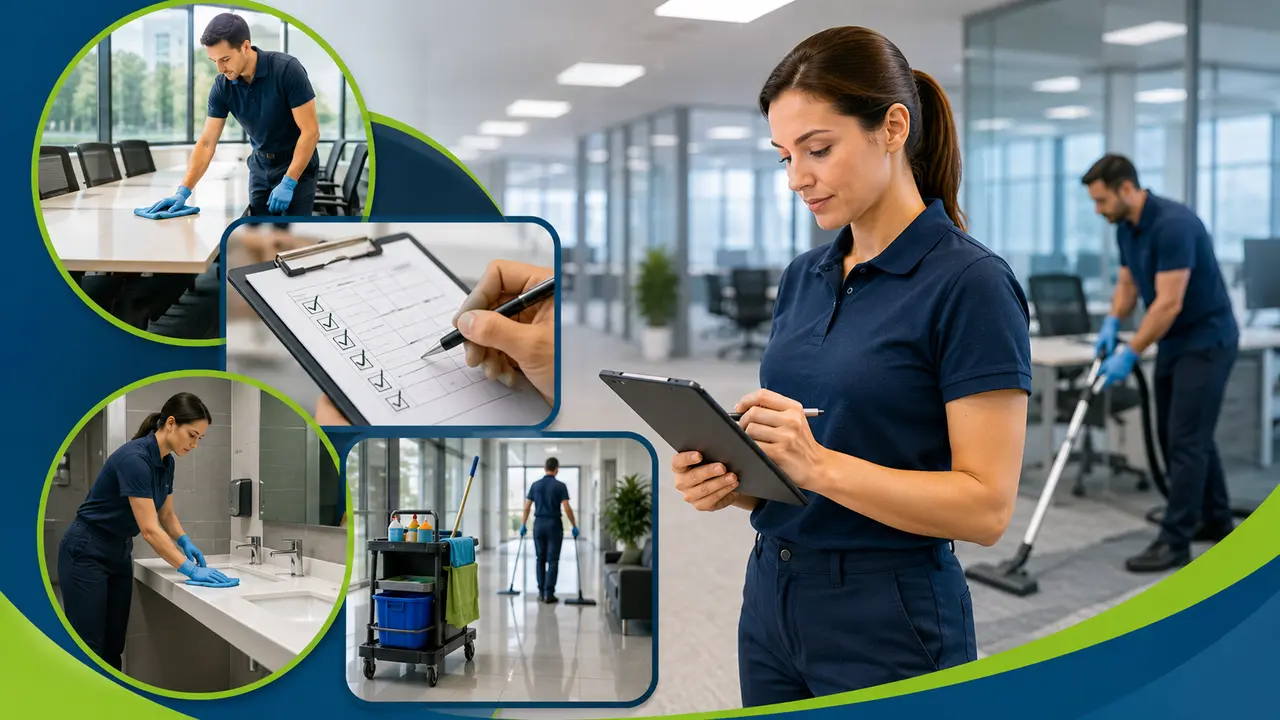
“The office looks clean” is an opinion. A cleaning audit turns that opinion into a number you can track, compare and act on. Auditing is how a cleaning contract stays honest over time — it catches slippage early, evidences standards for compliance, and gives both provider and client a shared, objective view of quality. This guide explains how a cleaning audit actually works, what gets measured, and how scores feed back into better cleaning.
Quick answer: A cleaning audit is a structured inspection that scores cleanliness against a defined checklist of areas and elements. An auditor works through each area, marks whether each element meets the standard, and the results roll up into a percentage or star score. Audits are done at a frequency matched to risk, results are shared and trended, and any failures trigger corrective action. Done well, auditing turns “it looks clean” into measurable, evidenced quality.
Why audits exist
Without measurement, cleaning quality drifts. Standards that were tight at mobilisation quietly slip; problems only surface when someone complains. An audit replaces that reactive cycle with a proactive one — regular, objective checks that catch issues before they become complaints. Auditing also serves compliance: in regulated settings like healthcare, you have to evidence that cleaning meets a standard, and audit records are that evidence. And it builds trust: when a client and provider look at the same scores, conversations about performance become factual rather than adversarial.
How a cleaning audit works
Most audits follow the same basic shape, whatever the setting:
| Stage | What happens |
|---|---|
| 1. Define the standard | Agree the checklist — the areas and elements to be assessed and what “pass” looks like |
| 2. Inspect by area | The auditor works through each area, checking each element against the standard |
| 3. Score | Elements are marked pass/fail; scores roll up into a percentage or rating per area |
| 4. Report | Results are recorded, shared with the client and trended over time |
| 5. Corrective action | Failures trigger a fix and, where needed, a change to method, training or frequency |
The corrective-action loop is what makes auditing worthwhile — a score that no one acts on changes nothing. Good auditing closes the loop.
What gets measured
An audit checklist covers the tangible things that add up to a clean, safe environment. Typical elements include:
- Surfaces, floors, fixtures and fittings cleaned to standard
- High-touch points sanitised — handles, switches, shared equipment
- Washrooms and kitchens clean, stocked and hygienic
- Waste removed and bins managed correctly
- Equipment stored properly and colour coding observed
- Consumables topped up and no maintenance issues left unreported
Frequency, transparency and trends
How often you audit should track risk: higher-risk areas — clinical spaces, washrooms — warrant more frequent checks than a quiet storeroom. Just as important is what happens to the results. Audits that sit in a drawer achieve nothing; audits that are shared with the client, discussed and trended over time drive improvement. A downward trend flags a problem before it becomes a complaint; a stable high score is evidence the contract is being delivered. In healthcare, this feeds directly into frameworks like the NHS cleaning standards, where audit scores translate into publicly displayed star ratings.
Joint audits and accountability
Some of the most effective auditing is done jointly — the provider’s supervisor and the client’s representative walking an area together and scoring it against the same checklist. It removes any argument about whether a score is fair, because both parties saw the same thing. Combined with regular internal audits by the provider, it creates layered accountability: the provider checks its own work, and the client verifies independently. That’s the model that keeps standards honest over the life of a contract.
Auditing built into your cleaning contract
At Crystal Facilities Management, quality auditing is part of how contracts are delivered — regular checks against an agreed standard, shared results, and a corrective-action loop that turns findings into fixes. It works hand in hand with the KPIs and SLAs in your contract and, in healthcare, with the NHS cleaning standards. If you want cleaning that’s measured rather than assumed, auditing should be written into the specification from the start.
Want cleaning that’s measured, not assumed?
Free site survey across London. We’ll build auditing into your specification from day one — agreed standards, shared scores and a clear corrective-action loop.
Request your free quoteor call 020 8993 3831
Frequently asked questions
What is a cleaning audit?
A cleaning audit is a structured inspection that scores cleanliness against a defined checklist of areas and elements. An auditor works through each area, marks whether each element meets the standard, and the results roll up into a percentage or star score. Audits are carried out at a frequency matched to risk, results are shared and trended over time, and any failures trigger corrective action. It turns a subjective “it looks clean” into measurable, evidenced quality.
How does the cleaning audit process work?
It follows a repeatable shape: agree the standard and checklist; inspect each area against it; score elements pass or fail and roll them into a rating; record and share the results; and act on any failures through a corrective-action loop. The final step is the most important — a score that no one acts on changes nothing. Good auditing closes the loop by feeding findings back into method, training or frequency.
How often should cleaning be audited?
Audit frequency should track risk. Higher-risk areas such as clinical spaces, washrooms and kitchens warrant more frequent checks than low-risk storerooms or quiet offices. The aim is to catch slippage in the places where it matters most, early enough to fix it before it becomes a complaint. Frequencies are usually agreed as part of the contract specification and align with any regulatory framework that applies.
What is a joint cleaning audit?
A joint audit is one carried out together by the provider’s supervisor and the client’s representative, walking an area and scoring it against the same checklist. Because both parties see the same thing, it removes any argument about whether a score is fair. Combined with the provider’s own internal audits, it creates layered accountability — the provider checks its work and the client verifies independently — which keeps standards honest over the life of the contract.
How do audits link to KPIs and compliance?
Audit scores are one of the main KPIs used to measure a cleaning contract, giving an objective quality figure to trend against target. In regulated settings they also serve compliance: audit records evidence that cleaning meets the required standard, and in healthcare they feed frameworks such as the NHS cleaning standards, where scores become publicly displayed star ratings. Auditing is what connects day-to-day cleaning to both contractual KPIs and regulatory expectations.
About The Author